A relationship links two people who are in your database but not in the same family — a brother and sister who each have their own household, a parent living elsewhere, a friend who brought somebody in.
It is a record of how people are connected, and a way to get from one of them to the other in a click.
It is not for the people already on one record together. Husband and wife, and children at home, are members of the same family — that relationship is already there.
Where They Live
Relationships belong to members, not to families. Open the person — the member page for the individual — and choose the Relationships tab.
If you are on a family record and don't see the tab, that is why: click through to the member first.
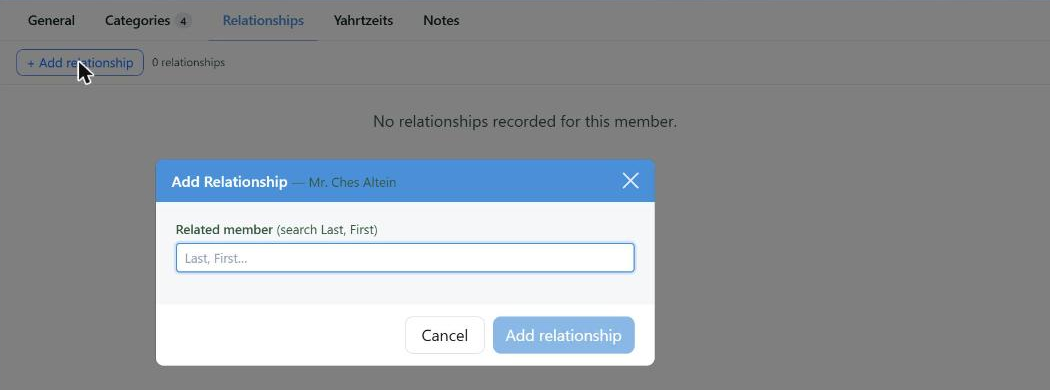
Add relationship asks for the other person by name; the relationship type is set once they are chosen.
Adding One
+ Add relationship, then search for the other person by last name, first name. Once they are picked, you say what each is to the other — Father and Son, Brother and Sister — so the link reads correctly from either end.
The relationship appears on both people. You add it once, from whichever of them you happen to have open.
What They Give You
- Navigation. Click the related person's name and you are on their record.
- Context. Anyone opening the record can see the connection, instead of it living in one person's memory.
- Yahrtzeit reminders. This is the one place a relationship does real work — see below.
What they don't do
Relationships are for recording and navigating. They are not report criteria, and they don't cascade anything — adding a category or a donation to one person does nothing to the other.
Relationships and Yahrtzeits
When somebody has passed away, the relationships on their record are what decide who gets the yearly reminder. Each one carries a Notify box, and the checked ones are emailed.
Those relationships are entered with the yahrtzeit itself rather than here, and they appear in both places afterwards — on this tab, and on the Yahrtzeits tab of the people being notified. Add Yahrtzeits covers entering them.
Worth Recording
- A child who has moved out and now has their own family record.
- Parents of a member who are in your database separately.
- Siblings in different households.
- Who brought whom — the friend or neighbor behind a new family.
The last one is easy to overlook and worth having. When you want to know who introduced a donor, this is the only place the answer lives.