Sometimes a family's giving history belongs on a different record. Two accounts turn out to be the same family, or a couple marries and their separate histories should become one. Moving the transactions by hand — deleting and re-entering — loses the receipt and invoice numbers, and is miserable work besides. This tool moves them in one step and keeps the numbers.
What Gets Moved
| Moved | Not moved |
|---|
| Every bill and payment, with their receipt and invoice numbers intact | Names, addresses, phone numbers and email — contact details are never merged |
| Submissions, unless you say otherwise | Categories, and saved credit card or eCheck profiles |
| Notes, if you check Move Notes | The original family record, which stays exactly where it was |
Doing It
In the sidebar, Tools → Move Transactions. The page is there for anyone who can edit transactions.
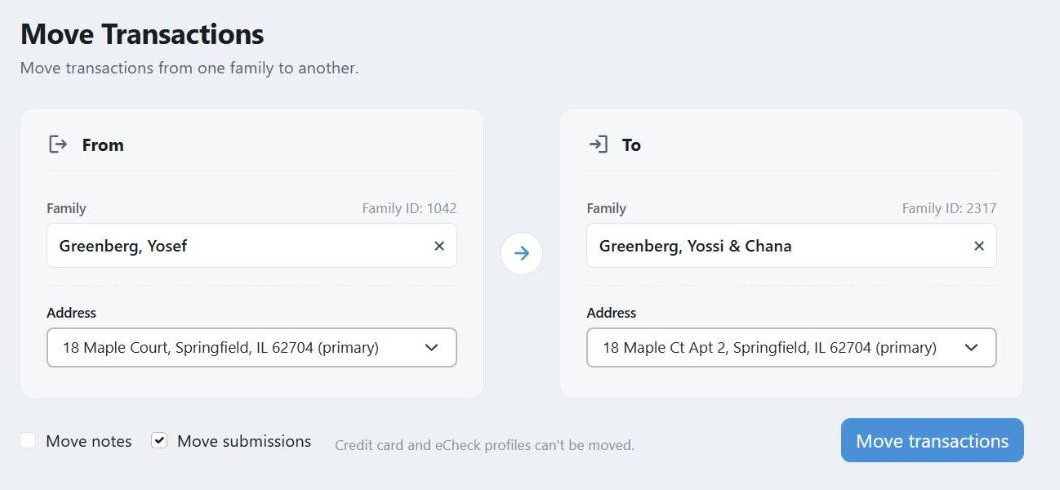
Both sides filled in. The giving on the left-hand address is about to land on the family on the right.
Fill in both sides:
- Choose the From family and address — where the transactions are now.
- Choose the To family and address — where they should end up.
- Check Move notes if the notes should go across too.
- Leave Move submissions checked unless you have a reason not to — submissions belong with the transactions they created.
- Click Move transactions. Before anything happens you get a count of the payments, bills, notes and submissions involved, and both families with their Family IDs and addresses.
There is no undo. Nothing stops you moving a lifetime of giving onto a family who has nothing to do with it. Read the confirmation — the two names and the count — before you click Yes.
Families With More Than One Address
Transactions belong to an address, not just to a family, so the move is from one address to another. If a family has a winter address and a home address, only the transactions on the address you pick are moved.
Every address on the family is listed, the primary one marked, so an old address is picked the same way as any other.
The same family can sit on both sides. Pick it twice, with a different address each time, and the giving moves from one of its addresses to the other.
Afterwards
The family you moved from still exists, with its name, address and categories — just no transactions. If it was a duplicate, that is usually the moment to delete it.
Check the receiving family's Transactions tab before you delete anything. A minute spent confirming the history landed where you meant it to is cheaper than the alternative.
When to Use It
- Duplicate families. The same household entered twice, each with some of the giving.
- A marriage. Two individual records becoming one household.
- A correction. Donations entered against the wrong family.
For finding duplicates in the first place, Tools → Find duplicates in the sidebar does the looking for you.
Article ID: 3758, Created: 6/10/2021 at 2:26 PM, Modified: 11/11/2026 at 9:07 PM