Routes turns a list of families into a drive. Pick who is getting a delivery, and CMS Cloud puts them on a map, works out the order that covers them in the least driving, and hands you a printed sheet or a link that opens the whole run in Google Maps on a phone.
It is built for the jobs that come round every year — Shalach Manos, Chanukah deliveries, Shmurah Matzah, hospital and shiva visits — where the list is already a category in CMS.
Before You Start
- The families come from a category. Make the category first and put this year's list in it.
- A route holds up to 23 stops. A bigger list becomes two or three routes — which is usually what you want anyway, one per driver.
Building a Route
Two ways in. From Categories, check the families you want and click Show map at the bottom. Or open Routes from the sidebar, go to the Categories tab and choose the category there.
Every family in the category is listed on the left and pinned on the map. The ones already checked in the category come in checked.
A pin on the map is not yet a stop. Tag the families this driver is taking:
- Click the tag icon at the right of a family's row, or
- use the lasso (the hand icon at the bottom left) to draw a circle around a cluster of pins on the map. Everything inside is tagged at once.
The × beside the lasso clears the drawing. Your tags stay.
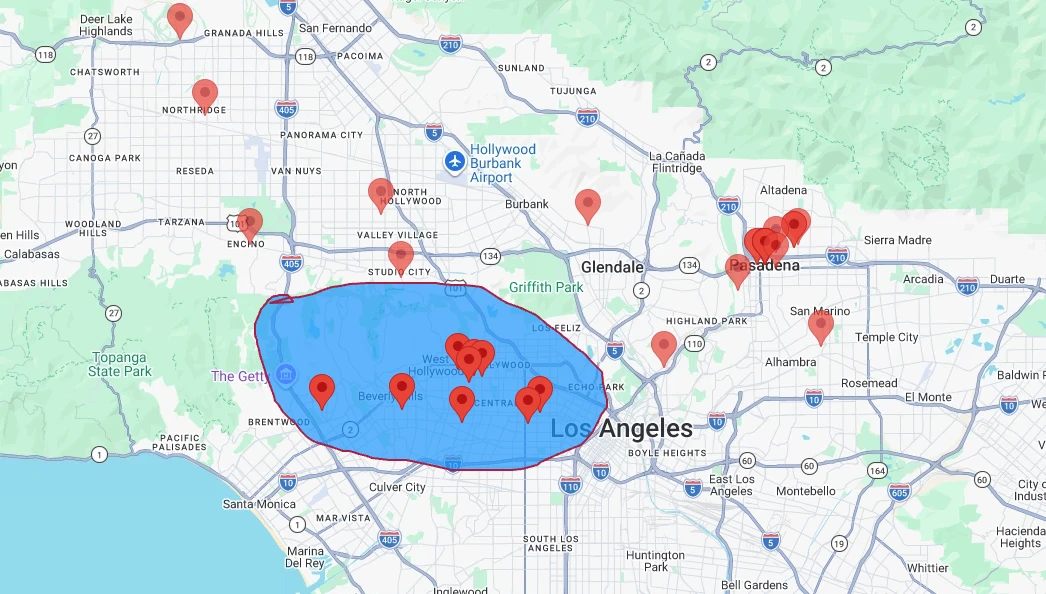
One lasso around a neighborhood tags every family inside it.
Tagging by neighborhood is what makes the whole thing work. Draw around a few streets, save that as one route, then lasso the next cluster for the next driver.
Click Create New and give the route a Name — something a driver will recognize, such as Shalach Manos · East Side. A Description is optional and prints at the top of the sheet.
The dropdown underneath decides what happens to those families back in the category:
| Choice | What it does |
|---|
| Uncheck Selected | The families you just routed are unchecked in the category, so what is left checked is what still needs a route. This is the default |
| Leave Selected | The category is left exactly as it was |
Click Save. The route appears in the Routes tab at the top.
With the route selected, click Show Route. The Route Settings window asks where the drive begins and ends:
- Start Address — pick a Department, pick a Family, or type any address.
- End Address — the same three choices. Put your own address here when the driver is going home at the end, or the shul's to come back.
- Start Date and Start time — when the drive begins.
- Wait time at each location — minutes spent at each door, five by default.
Click Show Route and the map draws the drive with the stops lettered A, B, C in the order to visit them. The order is Google's own, worked out from live traffic — not the order you tagged them in.
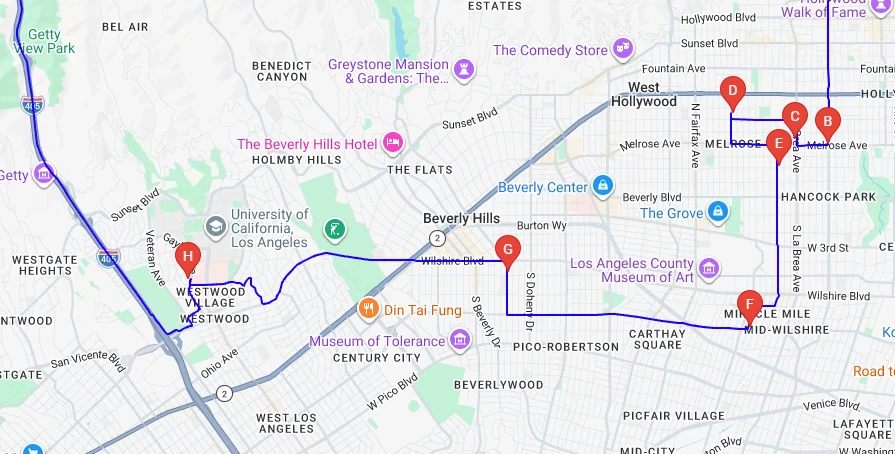
The finished route. The letters are the order to drive them, not the order they were tagged.
Taking It With You
Once the route is drawn, two icons appear at the bottom left:
- Copy Route Link — copies a Google Maps link. Paste it into a text message to the driver and it opens in Google Maps with every stop in order.
- Send route — emails that link. The message is already filled in with the route name and the link; set who it goes to and send.
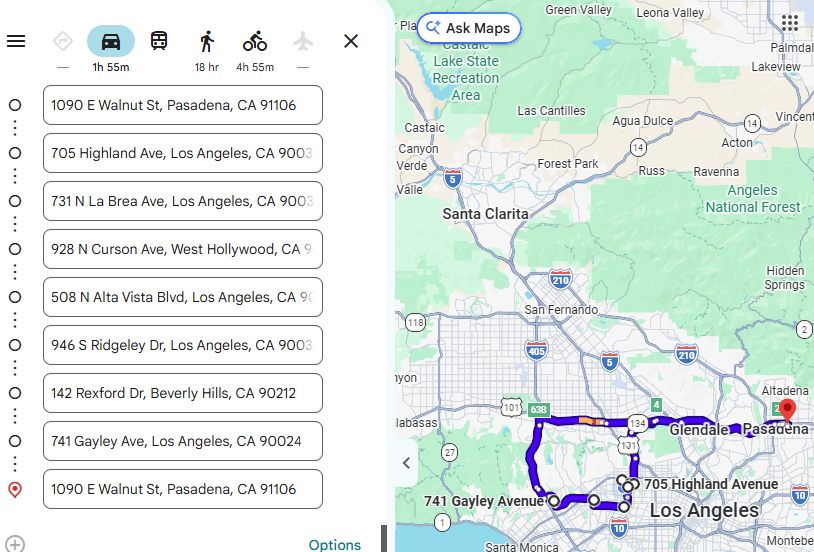
The same route opened from the link — every stop in order, ready to drive.
Google Maps allows ten points in one link. A longer route is split into several links, numbered in the order they are driven — finish the first, then open the second. The email carries all of them.
The Printed Sheet
Print asks the same Route Settings questions and produces a PDF to hand the driver. For each stop it prints:
- the time to be there, counted from your start time with the travel and the wait added up,
- the family's name with their home and mobile numbers,
- the address,
- and the miles and travel time to the next stop.
Total miles and total travel time are at the end.
The phone numbers on the sheet are worth more than they look. A driver who can't find the door calls from the curb instead of driving back.
Changing a Saved Route
Choose the route in the Routes tab. It opens showing only its own families.
Check Update and the rest of the category comes back into the list, so you can tag a family that was missed or untag one that has moved. Click Update Current to save. Unchecking Update before saving puts everything back as it was.
The trash icon deletes the route after asking. The families are not touched — only the route.
While a saved route is open, the list offers only families that aren't on another route, so you can't quietly take a stop off another driver. Building a brand new route offers everyone in the category, routed or not — which is what Uncheck Selected is for: what is still checked is what still needs a driver.
When an Address Can't Be Found
A family whose address Google can't place shows a warning triangle in its row and has no pin on the map. Click the triangle and the Enter correct address form opens with the address, city, state, zip and country. Fix it, click Save, and the family is placed on the map — and the family's record is corrected at the same time. If the new address still can't be found, the form says so and saves nothing.
Apartment and suite numbers are the usual culprit, followed by a missing city or zip.
Worth Knowing
- Click a family's name and its pin bounces on the map. Double-click and the map centers on it.
- Click a pin to see the family's name and address; the name opens that family's record in a new tab.
- Zooming and panning the map does not disturb anything you have tagged.
- The header at the top of the panel shows which route or category you are working in, and the arrow beside it folds the panel away to give the map the whole screen.