The QuickBooks integration means entering a payment once. What you record in CMS — the families, the amounts, the bank account, the subcategories — goes to QuickBooks Online as a deposit, with one click from the Deposits list.
Connecting a Company
Go to Settings → Financials → QuickBooks.
Click QB Connect, sign in to QuickBooks Online if you aren't already, and authorize CMS Cloud to view and update your data.
In QuickBooks Online, open Apps and look for CMS Cloud under My Apps.
Go to Settings → Financials → Departments, edit the department, and choose the QuickBooks company. This is required. Until a department points at a company, CMS has nowhere to send its deposits and nothing will go across.
You can connect several QuickBooks companies, each tied to its own department. Start with one and add others once the first is running smoothly.
The same screen later offers Disconnect, and a re-authorize option for when QuickBooks asks for permission again.
What Matches What
Each thing in CMS has a counterpart in QuickBooks:
| In CMS | In QuickBooks |
|---|
| Families | Customers |
| Bank accounts | Bank accounts |
| Payment methods | Payment methods |
| Subcategories | Service items |
| Classes | Classes |
You are asked where something belongs the first time it is sent, and the answer is remembered. Get the bank accounts, the payment methods and the subcategories you use most matched up on that first deposit, deliberately — they come up on every deposit afterwards, so a wrong answer there is one you keep seeing. Families need no preparation at all; match each one as it turns up.
Sending a Deposit
Work as you always do: record payments, group them into a deposit. On the Deposits list, each deposit that hasn't been sent yet offers Add to QuickBooks. One click sends every transaction in it.
If everything in the deposit is already matched, it goes straight over. Otherwise the Map to QuickBooks window opens first.
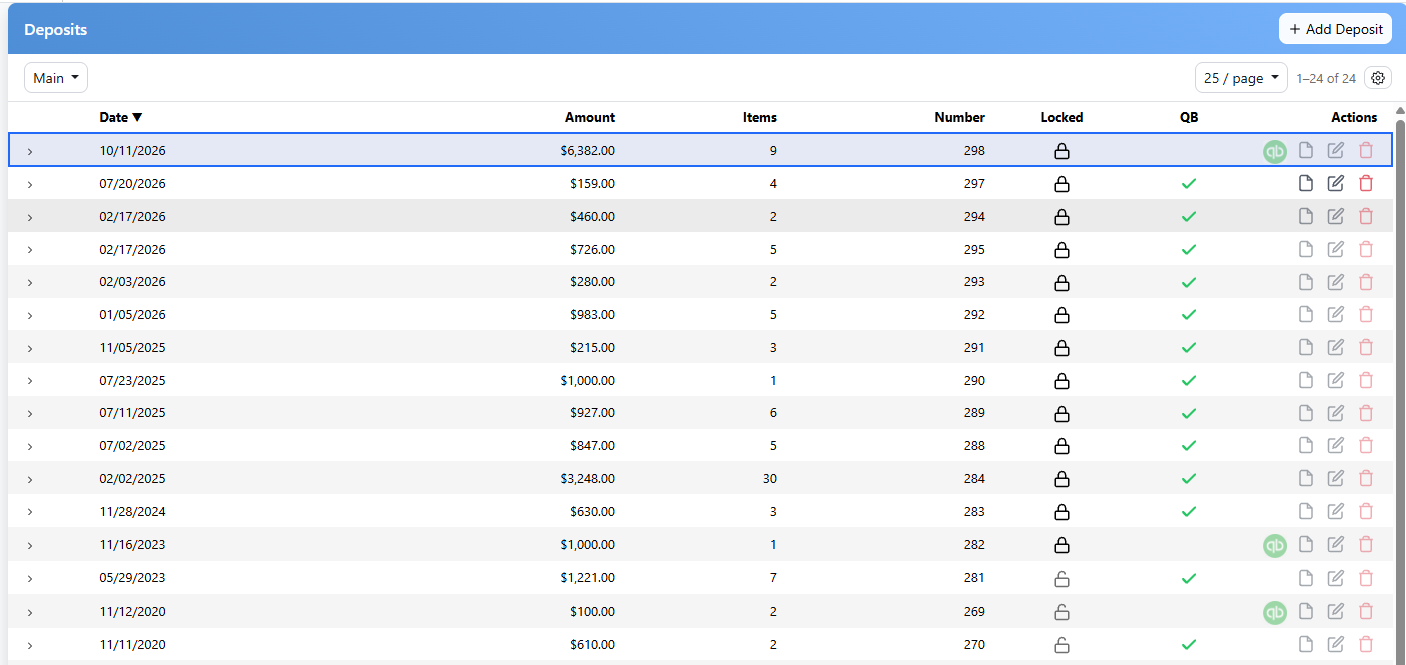
The QB column: the green icon sends that deposit, a check mark means it is already in QuickBooks.
The Map to QuickBooks Window
It lists only what still needs an answer, grouped into Families & Customers, Bank Accounts, Payment Methods, Items and Classes. Items are your subcategories, listed as Category: Subcategory. Each row shows where it stands:
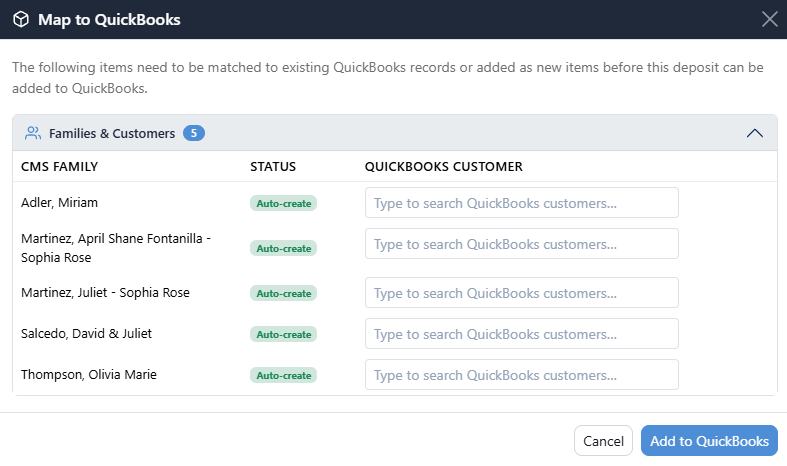
Families waiting to be matched. Leave a row alone and QuickBooks gets a new customer; start typing to pick the one that already exists.
| Status | Meaning |
|---|
| Matched | You've picked the QuickBooks record it belongs to |
| Auto-create | No match chosen, so QuickBooks gets a new record — the usual answer for a family or a bank account that isn't there yet |
| Action required | You have to decide. Items and classes are never created silently |
For a family, start typing to search your QuickBooks customers and pick one. For accounts, methods, items and classes, choose from the list. Items and classes also have + New, which creates the record in QuickBooks — a new item asks for its name and income account.
Add to QuickBooks at the bottom stays disabled until nothing is left unanswered. A red note beside it says what remains, and clicking it jumps to the next row needing attention.
Matching a family to an existing customer is worth the few seconds it takes. Auto-create makes a second customer record when one already exists under a slightly different name.
After It's Sent
The deposit is recorded in QuickBooks and no longer offers the button, so the same deposit can't be sent twice. While an export is running the other deposits' buttons are held, which keeps two exports from overlapping.
Send deposits rather than individual payments, and let the deposit be the thing both systems agree on. That way the bank statement, the CMS deposit and the QuickBooks deposit are the same figure.