A year-end letter is the one acknowledgment that sums up a donor's whole year: what they gave, when, and the total. It is the letter people keep for their taxes, and the one letter of the year that goes to everybody at once — which is exactly why it is worth setting up carefully and testing on a handful before the run.
Before You Begin
- Everything is entered. A donation keyed in after the letters go out means a correction letter.
- Your stationery is ready as a PDF template.
- Your year-end letter is written and read by someone else.
- You have decided how it goes out — email with the PDF attached, or printed.
Step 1: The PDF Template
Go to Settings → Communications → PDF templates and set the Type to Year End. Edit the existing template or create one.
Prefer to watch? Video: Year-End Letters runs about two and a half minutes, start to finish.
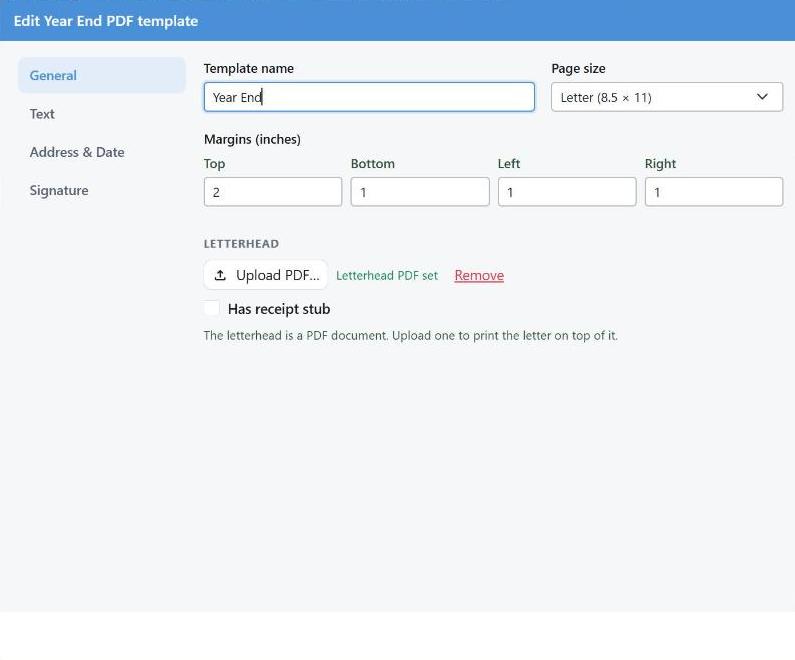
The preview on the right is a real letter on your stationery, so the margins can be judged by eye.
Set the page size, upload your letterhead, and set the margins so the text clears it. The preview updates as you go.
The signature block
On the Signature tab, check Show signature block and fill in the closing, the signature image, the name and the title.
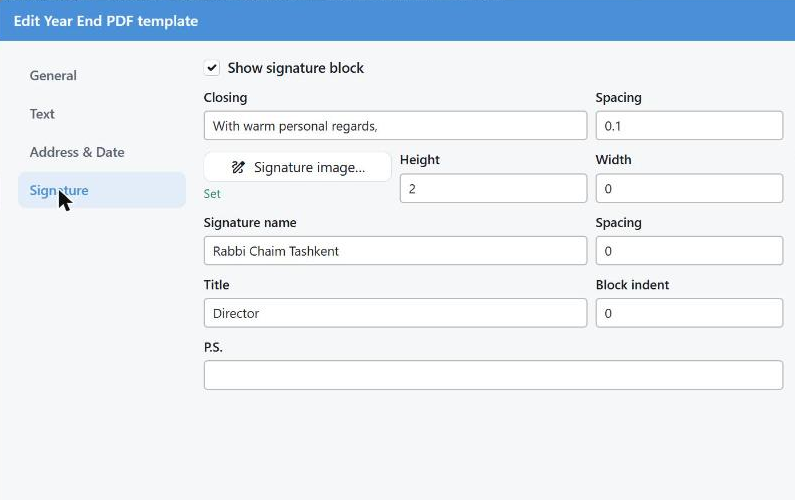
Set once here, and it lands wherever the letter uses the signature field.
The signature block belongs to the PDF. It appears where the {{SignatureBlock}} field sits in the PDF text, and not in the email version at all — emails are signed in the body like any other letter.
Step 2: The Letter
Go to Settings → Communications → Letters and set the Type to Year End.
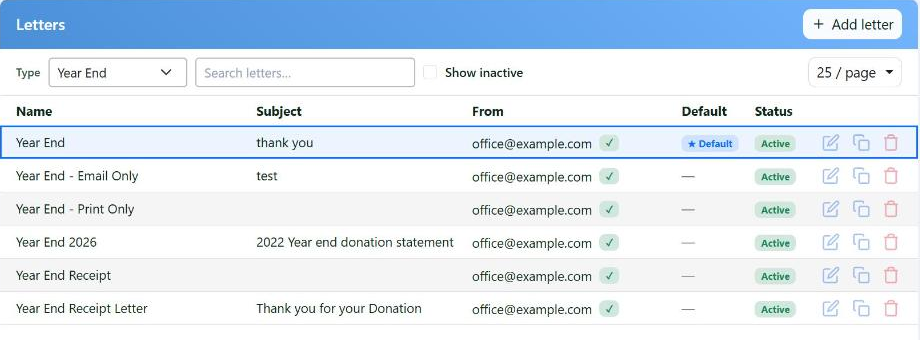
Your year-end letters. One is marked Default.
Open one, or add a letter. Under Details you set the name, the subject, and the from name and mailbox — the domain has to be one you have verified, which it shows with a check mark.
Then there are two bodies to write, and the difference matters:
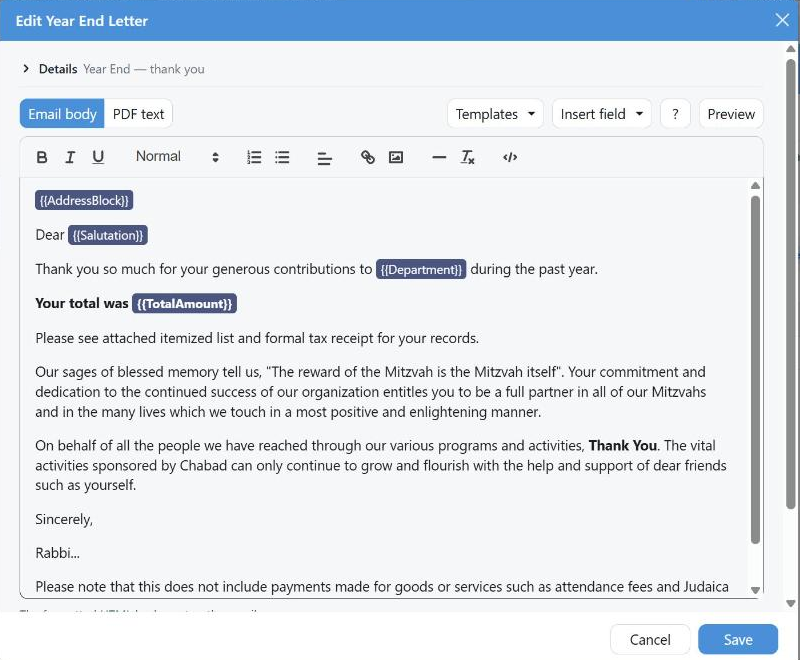
Merge fields appear as chips. Insert field adds them; the chip is replaced with the family's own details when the letter goes out.
| Tab | What it is |
|---|
| Email body | What the donor reads in the email itself. Formatted — headings, bold, links |
| PDF text | What prints on the attached PDF, on your stationery. Plain text, laid out by the template |
Fields worth knowing
Insert field puts a merge field at the cursor. A few are particular to year-end letters:
| Field | What it becomes |
|---|
| {{TotalAmount}} | Everything the donor gave over the year, as one figure |
| {{TransactionList}} | The itemized list of their donations — the part people check |
| {{SignatureBlock}} | The closing, signature, name and title from the PDF template |
| {{PageBreak}} | Starts a new page — usually put before the transaction list so the letter reads as a letter and the list has a page of its own |
| {{Salutation}}, {{AddressBlock}} | How this family is addressed, from their own label and salutation settings |
The PDF template usually places the salutation and the address block for you, on its Address & Date tab. Only add these fields to the text if the template isn't doing it — otherwise each family gets their name and address twice.
Preview shows the letter filled in with real details before you commit to anything.
Step 3: Sending Them
Year-end letters go out from Batches, the same way other letter runs do: choose the year, choose email or PDF, preview the list, then send or download.
Send a handful to yourself first. Check the total against a report, check the itemized list, and check the letter looks right on paper as well as on screen — then release the rest.
Worth Knowing
- Mark one letter as Default. That is the one used when nothing else is chosen.
- Keep last year's letter. Duplicate it and edit the copy — the duplicate button is on the letters list — so you always have what you sent last time.
- A donor with no email simply comes out in the printed run instead. The Delivery setting on the batch is what decides that.